Accelerating climate action in unfavourable local contexts: the role of policy entrepreneurship
This section probes the theoretical approach introduced in the previous section, based on evidence collected through elite/expert interviews with local politicians and policymakers (see Fig. 1). Drawing on Capano and Galanti’s conception of policy entrepreneurship29, the analysis unravels patterns of agency through which policy actors in the decision-making arena of Blackpool produced a high-quality climate action plan. It begins by explicating evidence on the reasons why policy actors and institutions sought to accelerate local climate ambitions within an unfavourable context, namely their entrepreneurial motives.
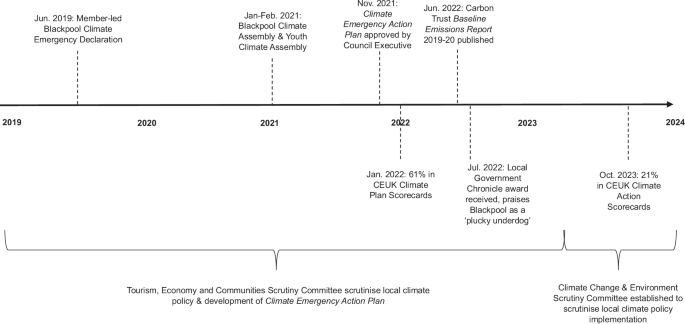
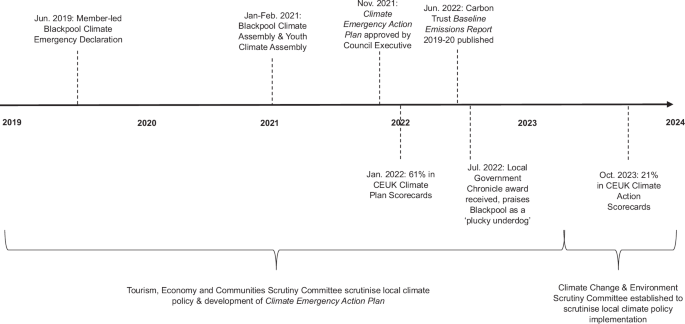
This timeline is inexhaustive. It provides a summary of events noted as particularly important to accelerating local climate ambitions during elite/expert interviews.
Motives
Interviewees expressed a mixture of exogenous (extrinsic) and endogenous (intrinsic and context-specific) motivations for local climate action. Expertise gathered through higher education, research, and exposure to climate change-related impacts outside of – not within – Blackpool were commonly cited as important exogenous motivators. However, interviewees also acknowledged how factors specific to Blackpool were also prominent, with many highlighting how place identity shaped decarbonisation efforts. For example, a desire to regenerate the town through post-industrial place-making – conscious of its external image as a declining seaside resort – was a recurrent theme across interviews.
Inter-party consensus among local politicians on the need for local climate action was another important endogenous factor. Political leadership came ‘early’ and ‘from the top’ (Interview #2), epitomised by a councillor-led climate emergency declaration in 2019 (Document #3; #4). This coincided with a desire to capitalise on ownership of a suite of public assets, including multiple modes of public transport, housing companies, iconic tourist attractions, and a disused (and ‘economically unviable’) provincial airport (Interview #6, see, e.g., ref. 43).
Climate ambition was accelerated by several passionate council officers motivated by a desire to go above and beyond their job specifications and a broader belief that climate action was the right thing to do. Many acknowledged a sincere commitment to make a difference, with one officer emphasising the importance of political leadership to maintaining momentum for local climate action: ‘if the members lose interest in it […] the push falls apart.’ (Interviewee #2). In short, council officers weren’t solely motivated by delegated responsibility and political support; an intrinsic desire to make a difference was also crucial.
Respondents also repeatedly noted a desire to operationalise and embed climate justice as a normative imperative within Blackpool’s Climate Emergency Action Plan. This was supported by an approach which framed local climate action as an economic opportunity through which wider societal issues – including energy costs – could be tackled. In short, the articulation of local climate ambition was interwoven with place identity:
‘It seems counterintuitive: why are poor people […] arsed about any of this? […] Part of it is to do with […] climate injustice […] being seen, described, and understood as a core part of the condition of injustice and disadvantage in those spaces […] it’s become a more important public policy concern and question […] beyond merely an economic status thing to something that’s about culture […, it’s] different from it being spurred by the fact that […] we’ve had loads of floods recently […] there’s something about the politics of the place […] that’s been a key way that we can explain why […] this has become a big issue.’ (Interview #6).
The evidence so far reveals a mix of exogenous and endogenous motivations for accelerating local climate actions (see Table 1), challenging assumptions that policy entrepreneurship is solely driven by a steadfast desire to implement policy solutions envisioned a priori in favour of a more nuanced, place-based understanding39.
These motives coalesced to contextualise a collective goal of leading by example within Blackpool’s Climate Emergency Action Plan (Document #1), encapsulated by how despite competing policy priorities there was an institutional desire: ‘to set an example and say this can be done, and then […] maybe other people might do the same.’ (Interview #2; see also Document #23).
The next section will explore how these motives informed the operationalisation of entrepreneurial strategies via a pattern of agency to affect change.
Strategies
When reflecting on how they – or others – went about influencing the creation of Blackpool’s Climate Emergency Action Plan, interviewees evoked Capano and Galanti’s four ‘prevalent activities’ – or entrepreneurial strategies – through which policy actors seek to navigate a specific policy context and bring about policy change, thereby distinguishing themselves from leaders, brokers, and/or experts29. These strategies encompass: framing problems and ideas; developing policy solutions; building coalitions; and seeking opportunities and attention29. Importantly, analysis reveals how these strategies were tailored to the local context to create a high-quality climate policy output. The following section examines these archetypal strategies with reference to elite/expert interview data.
Framing problems and ideas
Framing involves rhetorical persuasion, namely making policy ideas (more or less) robust by repackaging existing terms or inventing entirely new ones to frame policy solutions in innovative ways. Effective framing necessitates expertise, time, and/or resources to challenge pre-existing policy agendas and advocate for – or ‘soften up’ – new ideas across diverse stakeholders. Actors can operationalise their ideational agency – namely, an ability to manipulate ‘knowledge and information…to influence the policy design process’44, which comprises cognitive (technical aspects of an issue) and normative (underlying values) dimensions – to capitalise on polysemy and ideational ambiguity to (re-)articulate ideas in their favour45. Rhetorical persuasion is particularly effective when it frames a proposed policy solution as inevitable, emphasising the positive valence and emotional intensities underpinning proposed solutions46.
Framing local climate action as a ‘climate justice’ issue was foundational to maintaining climate action following Blackpool’s climate emergency declaration. Council officers – at various levels of seniority – leveraged their ideational agency to construct the meaning of local climate action. Officers substantiated councillor-led calls to treat local climate action ‘like an emergency’ (Interview #5) by framing climate action as a justice issue to ‘snare’ public interest and embed climate policy implementation within the ‘agenda for tackling inequality’ as opposed to an economic cost (Interview #6; Document #23; see, e.g., ref. 47). This echoes existing literature on the value of emphasising the ‘co-benefits’ of net zero policy48.
Ideational agency was also crucial to re-framing climate action as an economic opportunity, or ‘new area of business’ (Interview #6), to ensure widespread buy-in across all policy directorates within the council. Interviewees underscored the importance of framing to pacify climate whataboutism: ‘our emissions per capita are a hell of a lot lower than most other places […] there’s that […] argument […] is it our problem to solve? And we […] translated that into: if Blackpool can make a difference […] that’s […] a marker for other places that are clearly emitting beyond what is reasonable.’ (Interview #5).
This problem framing was disseminated and further developed through dialogue with local residents during Blackpool’s Climate Assembly and Youth Climate Assembly. These events – which were instigated by council officers with a desire to avoid ‘tokenistic’ public consultation – were pivotal to legitimising climate action as a climate justice issue with a diversity of stakeholders and elongating temporal horizons within the council. In responding to the importance of a ‘fair and just transition’ to participants of the Blackpool Climate Assembly, council officers described how they framed local climate action in response to thorny issues of responsibility: ‘we’re not just this […] tiny unitary authority on the Fylde Coast that’s […] got to tick all these boxes […] it’s actually about doing something meaningful for the rest of the town […] we have got a really unique demographic being one of the most deprived [local authorities in England].’ (Interview #4).
To this end, actors demonstrated the validity and effectiveness of ‘different ways of knowing’ local climate action through an explicit focus on co-benefits48. Council officers framed climate policy as a ‘new’ policy agenda, adopting a ‘big bang’ approach to ‘get everybody moving and thinking’ and provide various entry points for people to buy into climate action (Interview #5). This finding lends credence to the notion that while the capacity to – for example – exercise rhetorical persuasion is often most abundant amongst individual actors with substantive epistemic authority (e.g., policy elites), it can also be effectively exercised by actor collectives with comparatively less ideational power. The effectiveness of this approach was underscored by the direct inclusion of 31 recommendations from the Climate Assemblies within Blackpool’s Climate Emergency Action Plan, alongside a clear emphasis on the co-benefits of climate action and climate justice as key, overarching themes.
To summarise, local climate action was collaboratively framed by council officers – in collaboration with local politicians, experts, and citizens – as a climate justice issue and route to economic growth. In short, the fit between ideational agency (problem framing) and structural factors (the local socio-economic context) mattered.
Developing innovative policy solutions
Actors can pursue policy change by recombining and/or repackaging policies and problems to develop innovative solutions. This often involves ‘developing policy contents with stakeholders and verifying policy solutions with experts’ whilst also amassing evidence to demonstrate the practical and political viability of a proposed policy solution29. Knowledge and expertise are particularly useful in translating ideas into feasible projects, adapting to politicised contexts, and building effective teams to support the implementation of innovation solutions.
While existing literature often presents climate action planning as ‘a matter for bigger and wealthier cities’49, council officers identified a plan as an appropriate and feasible next step post-declaration, advocating for the solution across decision-making forums despite capacity constraints. A plan was positioned as a suitable location for an ambitious vision to be articulated, epitomised by the adoption of a net zero by 2030 target, exceeding the national-level 2050 target. Crucially, this approach was bolstered by cross-party support for the acceleration of climate action and enlisting external experts to deliver key activities (e.g., the Carbon Trust to undertake a ‘gap analysis’ and provide ‘technical upskilling’, Interview #1; Document #26).
An ability to identify and leverage pots of funding (e.g., for Carbon Literacy Training; Document #20, and an internal Climate Action Fund; Document #25) was also central to this approach, with one interviewee describing how: ‘a feature of our entrepreneurial approach is when […] it has a business case, we are unafraid to […] invest [in local climate action]. Many councils won’t do that, [but] we do […] we’re prepared to take appropriate risk to deliver […] in quite innovative ways’ (Interview #6).
Interestingly, despite suggesting that the planning process was (largely) not reliant on ‘inter-authority collaboration’ (Interview #6), interviews did note the importance of translating and adapting policy instruments successfully implemented in other policy contexts or operationalising lessons learned from the Local Governance Association Corporate Peer Challenge (Document #18) to overcome internal capacity constraints (Interview #5). Nonetheless, one respondent noted that they still felt like ‘a poor relation’ when collaborating with other, more well-resourced local authorities (Interview #4) – which might complicate the delivery of climate ambitions articulated in the plan.
In sum, council officers – supported by local politicians, consultants, and experts – capably identified a climate action plan as a suitable policy solution, formulating a way forward that was (relatively) familiar within an institution (a local authority) that is often depicted as prone to path-dependency within existing literatures. Council officers demonstrated a specific capacity to innovate by securing pots of funding, innovatively developing – and where appropriate – taking best practice solutions from other policy contexts to overcome internal capacity constraints. Innovation was epitomised by the implementation of a ‘Climate First’ decision-making model, whereby to receive approval, council strategies/initiatives must demonstrate capability to contribute to net zero delivery.
Building coalitions
Coalition-building – forming alliances between diverse actors to garner support for/against local climate action – often depends on trust-building, effective networking, and an ability to determine an appropriate level of collaboration whilst avoiding unnecessary complexity. Any such judgement is (at least partially) determined by the particularities of the local context.
In Blackpool, coalition-building was skilfully operationalised to circumvent capacity constraints, with emphasis placed on regular scrutiny committee meetings with cross-party representation, establishing a Climate Emergency Steering Group (including local politicians, executive-level officers, and representatives of council-owned but disused assets), and recruiting ambitious recent graduates to form a climate policy team. While public/private sector pay disparities often limited the retention of junior officers, these activities were nonetheless important to help translate climate action across policy areas, dismantle institutional siloes, and establish partnerships with likeminded civil society actors, or ‘critical friends’ (Interviews #2, #7)50. One interview described how they were ‘always thinking about [how] everything […] fits in together […] I have conversations with the library service, with the arts service, and I don’t […] think that a lot of climate teams would do that.’ (Interview #5).
This pattern of agency underpinned the initiation of external partnerships to pursue innovation. Various relationships were established and nurtured with – for example – the Carbon Trust (to develop a carbon baseline, Document #26), TPXimpact (to convene Blackpool’s Climate Assembly, Document #14), and other local authorities in Lancashire (to pool resources and jointly commission reports, Document #29; #30).
This approach was central to sustaining support for local climate action in Blackpool despite capacity and resource constraints; underpinned by a fundamental belief that the presence of an imperfect plan was preferable to the absence of a plan and signified a substantive political achievement51. In short, coalition-building had a demonstrable influence on the quality of Blackpool’s Climate Emergency Action Plan, underscored by the identification of key delivery partners and commitment to establish a Climate Action Partnership (Document #7).
Seeking opportunities and attention
Innovation promotion can also involve seeking out opportunities and attention from a range of actors – whether internal or external to a local authority – and strategically recognising, creating, or manipulating decision-making arenas across policy contexts and/or governance scales. To this end, actors might collaboratively shift between – or even create – decision-making venues and utilise focusing events and/or windows of opportunity to affect policy change. This strategy often relies on social acuity, political acumen, and access to relevant decision-makers and resources.
In Blackpool, officers with a climate policy remit recognised that ‘for most people the action plan […] was the first real significant interaction with [climate change] in a workplace situation‘ and an opportunity to introduce local climate action ‘as a public policy concern’ (Interview #6). In response, officers worked across decision-making venues to ensure climate change was consistently included as an agenda item across council committees spanning different policy areas previously considered to be distinct from climate change (Interview #2). They also noted the importance of strategically utilising different decision-making arenas to ensure the input of a diversity of perspectives into the planning process (Interview #3).
The ability of council officers – at varying levels of seniority – to identify, and capitalise on, windows of opportunity was central to maintaining climate ambition, epitomised by one council officer’s reflection on an idealistic desire to: ‘go full tilt and do on street charging […, install] solar panel[s] on every roof’ while acknowledging that climate action is ‘far from a lot of people’s imagination’ due to structural constraints, and that there was ‘a bit of an ‘Overton Window’ […] really: what is achievable at this moment in time with what I’ve got in this context?’ (Interview #5).
Cross-party support for climate action was reflected in the relative lack of opposition actors (e.g., rival politicians with carbon-intensive vested interests) leveraging climate intermediaries (e.g., local journalists) to promote counter-narratives in a confrontational manner. While representatives of the local Green party did employ some outsider-lobbying strategies to advocate for more radical policy interventions (Interview #9), a lack of electoral success stymied their influence. Instead, local politicians set a collaborative, consensual tone through transparent engagement with external actors to ratchet up local climate ambitions (Interview #8).
The preceding evidence illustrates a composite group of climate officers who enlisted the support of climate leaders and experts and adopted a range of innovative strategies to ensure the timely and effective presence of a high-quality climate policy output in an unfavourable context. Nonetheless, some policy actors questioned their ability to have a clearly identifiable, ‘singular influence’ on local climate ambitions29. This links to the final element of the theoretical framework: entrepreneurial effects.
Effects
When reflecting on their individual agency, interviewees often downplayed their own impact but were happy to praise others. One senior council officer suggested that that they had been ‘helpful’ but not ‘transformational’ (Interview #6), acknowledging that they played a role in legitimising local climate planning, but that their success was contingent on the activities of less senior council officers, cross-party political support, and the contributions of external organisations with specific expertise. Meanwhile, a mid-level council officer acknowledged that while it was ‘very difficult’ to objectively distinguish their influence, if they hadn’t been involved, certain policy outcomes likely ‘wouldn’t have happened yet’, pots of funding for policy solution might not have been secured (with the majority of actions in the Climate Emergency Plan being fully costed, Document #1), and external relationships might not have been nurtured so assiduously (Interview #5). Similarly, they acknowledged that they had repeatedly gone ‘above and beyond what was expected’ of them, and in some instances even exhibited ‘bloody mindedness’ to affect policy change despite resource and capacity constraints (Interview #5).
Consequently, while policy officers shouldered varying degrees of responsibility, policy entrepreneurship could not be attributed to any one heroic, individual actor. Instead, a composite, ‘core group’ of climate policy actors assembled within the decision-making arena of Blackpool within ‘the teeth of austerity’ successfully pursued innovation promotion to create a high-quality climate policy output (Interview #6).
Interviewees noted how an actor collective operationalised an ‘holistic approach’ (Interview #2) to simultaneously frame the problems of the town in a new way (e.g., as a climate justice issue to legitimise climate action in the absence of any statutory obligation to deliver net zero52), develop innovative policy solutions to further legitimise planning (e.g., advocating for the creation of a climate action plan as a feasible way forward within an institution prone to path-dependency), engaged in coalition-building to support change (e.g., by effectively orchestrating internal and external actors), and successfully pursued opportunities for financial resources and attention (e.g., by securing funding early on).
This collective pattern of agency demonstrably influenced the timely presence of a high-quality climate action plan. Blackpool’s Climate Assembly was repeatedly mentioned as an innovative solution tailored to the local policy context, with one interviewee noting: ‘you could argue […] can we not just have an off-the-peg delivery model, because actually that will speed things up? […] there are other organisations [that] did that, but […] we ended up with a very “Blackpool” model that would work for us’ (Interview #5).
Notably, this collective pattern of agency also influenced longer-term normative changes, which helped institutionalise climate ambition:
‘It’s been a slow burn […] we’ve […] deliberately made choices […] that will make other people think this is worthwhile […] decarbonisation […] is 1752059248 a core part of our Economic Development Strategy […] five years ago […] people thought this was nothing to do with them, now […] climate change has acquired legitimacy and purpose […] independent of the core team and me […] by other people thinking, that’s no longer a problem or an imposition, actually there’s something in this that will help with […] wider social policy objectives or economic development objectives […] that’s a sea change where we were in 2019 […] part of [w]hat’s been achieved [is] by deliberately doing things that disrupt […] perception[s].’ (Interview #6).
Interviewees (e.g., #4, #5) attributed this change to collectively nurturing an institutional culture of ‘innovation, collaboration, and purpose’9 to enable ambitious – yet resource-constrained – actors to punch above their weight.
This pattern of agency was praised at the 2022 Local Government Chronicle awards, where judges applauded solutions designed ‘with affordability in mind’ and ‘the can-do spirit of the plucky underdog’ (Document #25).
link